
How does a small business thrive? Therapy.
May is Mental Health Awareness Month, so I wanted to share something you might not know about our photo studio: we give our employees 5 free therapy sessions a year, and once a year we organize a group therapy workshop together. We’re a small business so budgets are tight but we ALWAYS make room for this.
I could cite study after study of how beneficial addressing mental health in the workplace is for both large and small organizations, but chances are you’ve glazed over lots of them already and know the gist. Instead, I’ll tell you why our photo studio in particular finds this beneficial.
Photographers, makeup artists, and just about everyone in nearly every creative profession is a solo entrepreneur.
It’s just the way our industry has always worked. You are responsible for every aspect of your business from marketing the work you do, doing the work you do, and billing the work you do. And it can be a lonely island to live on when you’re at the mercy of yourself as a manager of your business while also being at the mercy of the business as its employee.
I started Organic Headshots in this way and for a while it was just me running all aspects of my business. Then I ran into the problem that all freelancers dream of. I had too much work. I couldn’t keep up with all of my amazing clients who booked me over and over again and new clients who found me because their friends and colleagues raved about my work (pats self on back). I had two choices: start saying no and work less, or expand and scale up.
In hindsight I think giving my studio a name like “Organic Headshots” and not what most photographers name their studios like “Michelle Kaffko Photography” was a premonition that my goals were bigger than just me.
And now we’re one of only a few commercial studios in the country with multiple photographers.
Our studio is different because we’re a collaborative of photographers and artists working together: we know that we’re fiercely independent by nature, but we crave connection and belonging to something larger than just ourselves. We hate the terms “employee” and “boss” because it’s too black and white of a distinction of how we want to feel in an organization. The first time someone referred to me as their “boss” I nearly barfed.
It’s taken me a decade of growth to understand why what we’re doing works so well: we know our roles are at their core indeed “employee” and “boss” to keep the business running smoothly and to keep order in the system. But we also found ways to connect beyond that simple relationship to become a true “workfam.” As the boss, there are very few big decisions I make without presenting the options to the whole team first and allowing them to weigh in. As employees, everyone feels confident in their abilities to advocate for themselves, to share ideas, and to identify and solve problems within the organization and the interpersonal relationships we’ve created with each other.
It’s the ideal situation that most organizations strive for, but how did we get there?
Simple: group therapy sessions. It all started when I had the idea to partner with a client of ours, Skylight Counseling Center, for a personalized workshop they could put together to teach us how to help manage clients’ anxieties while taking their photos. We got those skills and discussed the topic at length, but then the conversation in the group session turned to how WE feel as artists when a client does or doesn’t like their photo. Then it kept going to how we feel as workers in the photography industry and how we manage our own feelings with all the roles we take on.
After the session David Klow, the owner of Skylight, and I turned to each other and said the same thing at the same time: individual sessions. Organic Headshots started paying for individual sessions for employees to talk through whatever they need in order to get clarity on their work, their work-life balance, or whatever skills they identify that they could build to improve their quality of life.
The result was life-changing for all of us. One person had never had a therapy session before in their life until one of these free sessions. They now go regularly and attribute therapy to being better able to manage huge life changes that have come their way over the years and are generally feeling happier, stronger, and more fulfilled.
This spring, we had our annual group therapy workshop and the topic was a big one: internal conflict within the organization.
Even though we all get along so well as friends, it’s still a work relationship at its core, which is inevitably going to be fraught with miscommunication, conflicting work styles, differing personalities, and so on. We decided as a team to head off any resentments or difficulties at the pass and zap them before they become a problem.
Skylight brought us together with a framework to discuss better ways to communicate with each other. We learned how to truly listen to someone and how to truly be heard, and why that’s so important in our interpersonal relationships and for our own individual mental health.
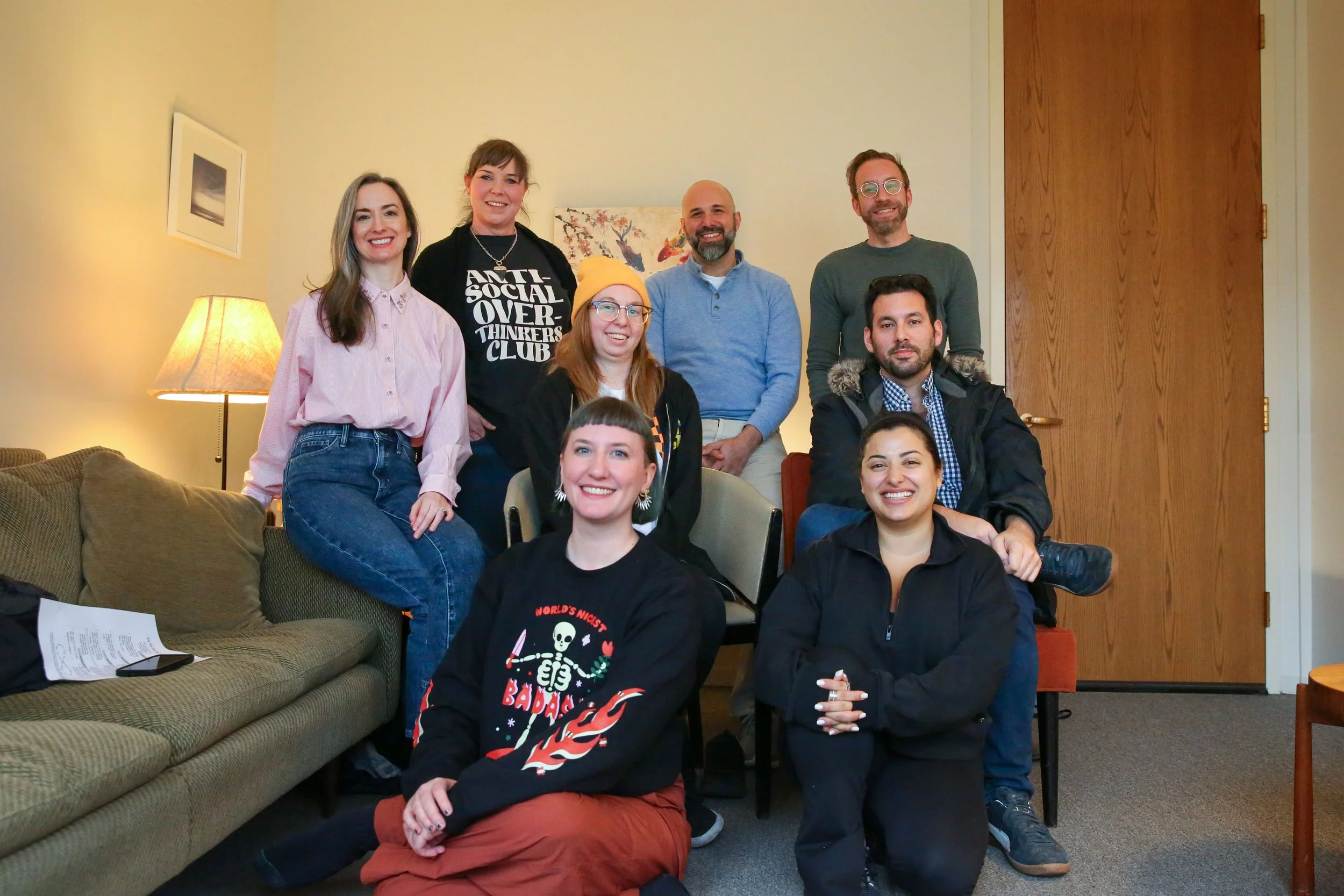
Now a small business like ours does have some advantages when it comes to managing mental health in the workplace. First of all, we’re small enough that we can easily get a group of its core members together for a workshop like this and have everyone willingly take part in it. This can sound like an overwhelming challenge for larger organizations with hundreds of team members scattered around the country or even the globe.
But I’m hoping our experience with addressing mental health in the workplace can be inspiring enough to consider it for your own organization: whether that’s just you as a solopreneur or a global workforce of tens of thousands.
Actually, let me rephrase that. I’m not a fan of the phrase “addressing mental health” because it sounds like trying to solve a problem.
You don’t have to be diagnosed with any kind of disorder or mental illness to have poor mental health, just like you don’t have to be diagnosed with arthritis to have knee pain.
Promoting better mental health in the workplace is just as important if not more so than promoting better physical health. Maybe it’s time to double that healthcare budget to allow for not just standing desks, a gym floor and free yoga classes, but some one-on-one therapy sessions too.
If a small business like ours and one of the few multi-photographer studios in the country can make it happen, you can too.