
Tall vs. short in a group photo
There’s something about group photos that can make someone only 3 inches taller than the person they’re standing next to look like LeBron James standing next to Simone Biles. Have you ever noticed this in a group picture you’ve been in? That you thought you were about the same height as your coworker but now that you see the two of you standing next to each other you’re like, “wait, what?”
How to pose group photos
When we’re posing groups for a photo we’re keeping two words in mind: shape and distraction.
A group photo is a photo made up of individuals, but for most group photos, you don’t want it to be about the individuals (if you did, it would be a photo of one person, not multiple people). You want everyone to appear equal, part of a team, and in essence, one entity or one “body” of people. Which means you want the group to have a shape.
That doesn’t necessarily mean that everyone should come together to form a perfect square or rectangle or triangle, but having a rough shape in mind when creating the group photo is key for directing the eye to keep moving through the shape and not getting stuck on any particular area. Can you see the rough shape of a triangle in this group photo?

One of the biggest things that keeps the viewer’s eye from moving around a group photo and makes it take that dreaded stop and stare at one part of the photo is a huge size discrepancy from one person to the next.
Which brings us to the word distraction. You don’t want there to be any glaring distraction in the group photo that grabs the eye and holds it there. You don’t want a viewer’s brain to think too hard about anything in a group shot, and “wow that person is so itty bitty and that person is so huge” is definitely a thought.
Here’s an example
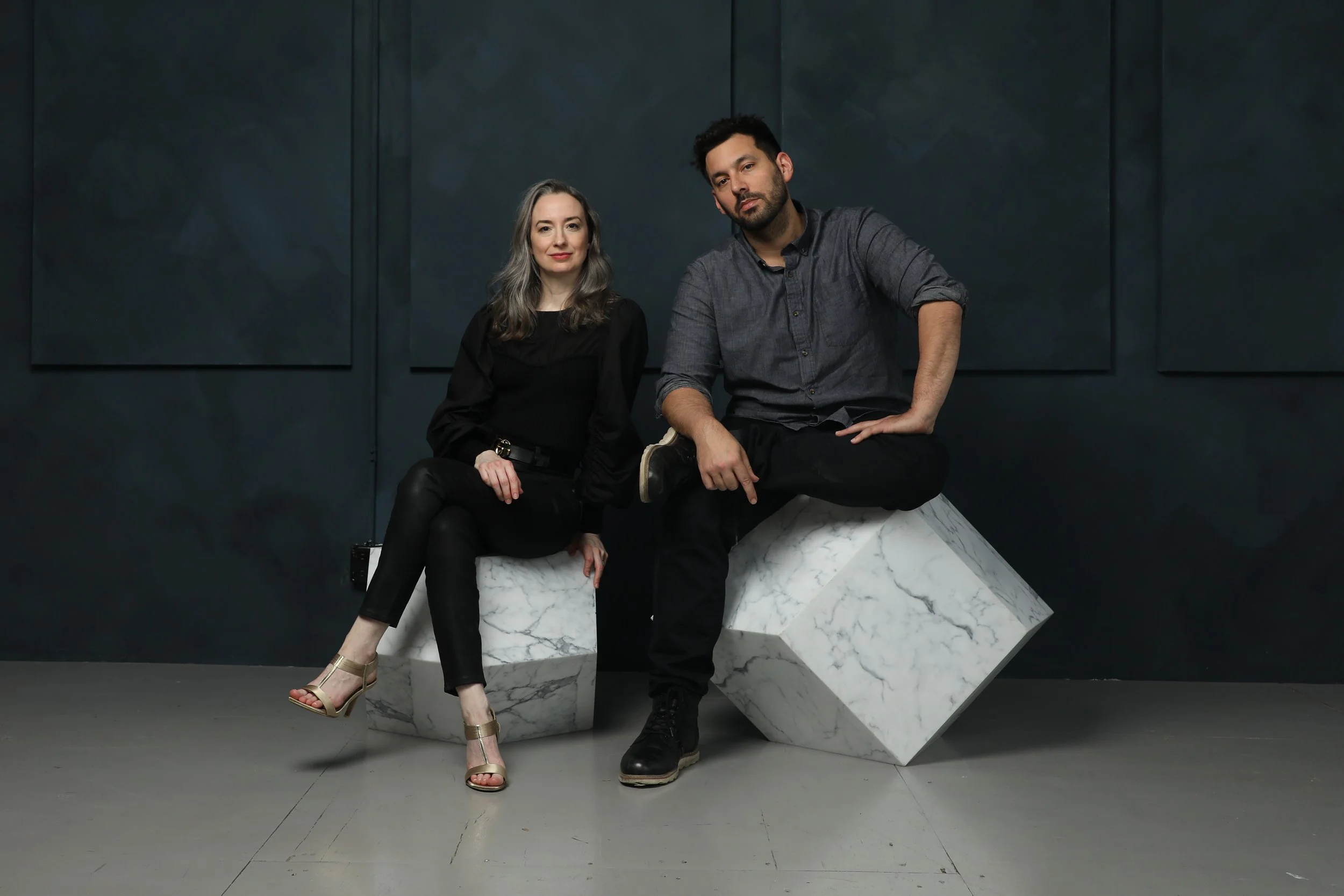
Let’s say you’ve got Michelle at 5’4” sitting on a small giant fake rock that’s about 6 inches shorter than a large giant fake rock. Can’t picture it? Here it is:

Now let’s put an Alexander, who is 6’2” tall next to the 5’4” Michelle onto the large giant fake rock.
Technically this is accurate. Alexander is larger than Michelle. Michelle is smaller than Alexander. Showing this is truthful, straightforward, and factual, right?
Here’s the thing, though: it’s distracting. Let’s say in this photo we want to show the two individuals as equal. They’re both photographers at the same photo studio with equal levels of skill and expertise and work cohesively as a team. Subconsciously, some people might look at this photo and think Alexander is “in charge,” in a way, or somehow superior to Michelle because he takes up more space in the frame. The difference in mass they have from each other in the photo makes us start to ponder what the team dynamic really is.
We can’t help it— it’s our lizard brains from millions of years of evolution drawing our eyes to the bigger thing in a picture because the bigger thing in the jungle is usually more threatening, dangerous, or more likely to have an impact on us than the smaller thing next to it. It’s just how we’re wired.
And in that group photo, you can actually see how the two people are trying hard to equalize each other. Michelle is sitting as straight up as she can to appear larger, and Alexander is slouching and leaning in toward her, as if to say, “don’t forget to look this way toward Michelle too, she’s figuratively just as big as I am.”
Now let’s do something as simple as placing Michelle on the taller rock, and Alexander on the shorter rock:

Woah. Now we’ve taken two people, who on Earth have different amounts of mass, and in a 2-dimensional photo we’ve given them what looks like the same amount of mass. It’s easier to visualize if we turn them into big black blobs to show much must space of the photo they’re each taking up:


And we still have a rough triangle shape where a viewer’s eye moves up, down, and around the frame at a good pace, without getting stuck at any distraction points.
It’s subtle, but something like moving the short person to the large giant fake rock and the tall person to the small giant fake rock is an important shift in not just creating a cool-looking group photo, but also in properly representing the team you’re photographing. It works with our lizard brains, the subconscious assertions we’re wired to make, and shape and art theory with imagery. BOOM.