
There are a lot of factors at play with a portrait such as lighting and posing, but nothing causes us to shriek “WOAH is that really how my face looks??” like the camera’s lens. Even if you were paying attention in high school physics on the day they taught reflection, refraction, and optics, it can be hard to understand why you look amazing in one photo and like your face has been stretched out and ironed flat in another.
Word of the Day: Distortion
When you take a photo with a camera, it’s the lens that converts the 3D world into a 2D image on the camera’s flat sensor. And different lenses will distort that 3D image in different ways to get it to fit onto the 2D surface of the film in your camera or the computer screen you’re seeing it on. “Distortion” means warping straight lines into curved lines. Wide angle lenses, such as 35mm and lower, cause barrel distortion, and longer lenses, such as 85mm and up, will cause pincushion distortion.
This means that with a wider lens things in the center of the frame can appear bigger and things at the edges of the frame will appear to move backward and seem smaller. Conversely, with a longer lens, objects at the edges of the frame can appear to move forward and seem larger.
Photographers use distortion as a tool in our art form to craft an image utilizing the lines and curves that a lens creates. In portrait photography especially, we’ll use lens distortion to draw the viewer’s eye toward what we want you to see, and away from what we want you to not notice as much.
Distortion vs. Realism
Our goal in a headshot is to create an image that looks as much like you as possible. So that means absolutely no distortion, right? So we should always use a lens that is closest to reproducing what the human eye sees, right? Yes and no.
The human eye perceives the world in the equivalent of about a 50mm lens. And most do people look good and like themselves at 50mm. But not everyone. And when we look at a 2D image taken with a 50mm lens it’s still not the same as the 3D image our brain creates when it takes the two 50mm lenses of our eyeballs and translates them into an image of the person in front of us.
Find Your Light, Find Your Lens
Let’s take this photo of Alexander with a 24mm lens and compare it to a photo of him taken with a 200mm lens.
24mm:
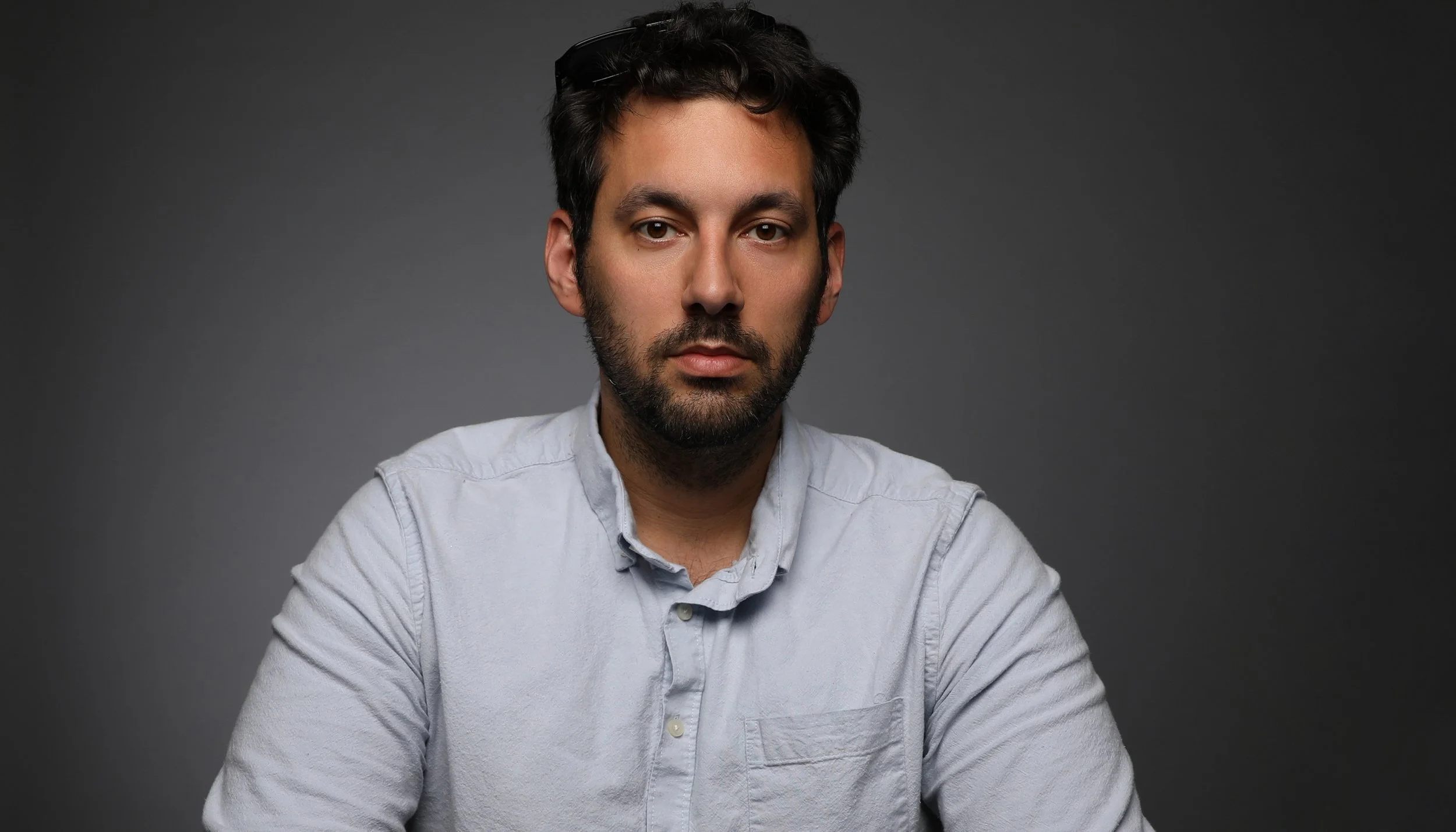
200mm:

In the 24mm lens, you can see the barrel distortion at play: the center of his face looks larger compared to the sides of his face and his shoulders and arms, which are rolling backward in the frame. And with the 200mm lens the opposite is happening with pincushion distortion and everything at the edges of the frame are coming forward and appearing bigger: his shoulders look wider, his face looks rounder, and his hair looks taller and fuller.
Right vs. Wrong?
Photography is an art form, so we hate saying something is “right” or “wrong” with our craft. Every aspect of photography is a tool to achieve someone’s goal, so at this point in a photo session we would defer to you. Which image feels the most accurate or appropriate to YOU? Which image of yourself do YOU feel looks the most like how you are or would like to be perceived in a 2D form?
This is why some people love selfies taken on their phone and others absolutely hate them. A phone camera is much wider (closer to the 24mm) so it’s going to change the shape of your face. Whether that works for you or not and you still feel like it’s an accurate and/or flattering depiction of you is in the eye of the beholder.
In our studio, we like to have a variety of lenses on hand: a 50mm prime, an 85mm prime, a 100mm prime, a 24mm-105mm zoom, a 24mm-70mm zoom, a 70mm-200mm zoom, and a 200mm prime, to be exact. This is because we like to have options when achieving our client’s goals so we can find the best lens for their specific face.
We don’t view each effect a lens has as a “pro” or a “con” of that lens, but more like a tradeoff. You can gain the effect of making a rounder face appear narrower and more sculpted with a wider lens, for example, but with the tradeoff of a larger-looking nose or a hairline that starts further back. We find the option that works best for you and combine it with light and posing to get the best photo possible.
What to Look For in a Headshot Photographer
If your photographer picks up a camera and they’re really close to your face while taking the photo, or they’re really far away from you, that means they’re deviating from the 50mm-85mm range most people look their best in, so find out why.
Make sure they’re making their decisions with your goals in mind and speak up if you think a part of your face or body in particular or your entire self in general doesn’t look like you. It’s their job to use lighting, posing, and lenses to create the lines that guide a viewer’s eye. It’s your job to provide feedback to help them, and that can absolutely mean saying “can we try a different lens to see how I look?”